Cavazaque Piu Piu: A Sensory Conceptual Art Exhibition
Introduction
Cavazaque Piu Piu is a contemporary solo exhibition that deliberately resists fixed meaning and straightforward interpretation. Rather than guiding the viewer toward a single conclusion, the exhibition creates an open environment where understanding develops slowly through sensory engagement. Confusion, deviation, and uncertainty are not problems to be solved but active components of the work itself.
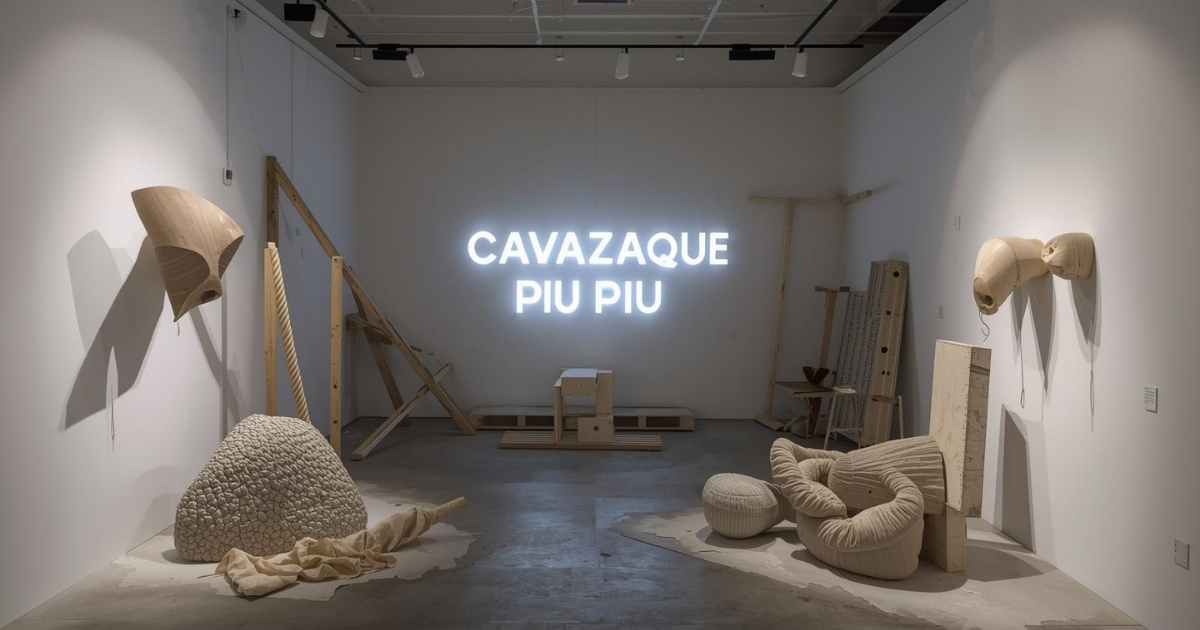
Exhibited at Galeria Quadrado Azul in Lisbon, Cavazaque Piu Piu combines sculpture, sound, and light into a unified installation. The project challenges dominant systems of knowledge by questioning how meaning is produced, communicated, and controlled. Through its experimental approach, the exhibition positions itself firmly within contemporary conceptual art discourse.
The Concept and Origin of Cavazaque
The term Cavazaque Piu Piu originates from a linguistic misunderstanding narrated by Francisco Moura, a steam-machine operator from Seixal. Instead of correcting this misunderstanding, the exhibition preserves it as a conceptual foundation. The phrase becomes meaningful precisely because it resists clarity and definition.
By keeping the term unresolved, Cavazaque operates as a flexible and unstable concept. It demonstrates how language can shift, mutate, and generate new interpretations over time. Meaning is not recovered or clarified, but continuously produced through repetition and misinterpretation.
Misunderstanding as a Creative Method
In conventional systems of knowledge, misunderstanding is often viewed as an error that must be corrected. Cavazaque Piu Piu intentionally reverses this logic by treating misunderstanding as a productive force. The exhibition suggests that certainty can limit thought, while confusion can open new intellectual paths.
By allowing ambiguity to remain unresolved, the work creates space for speculation and imagination. Knowledge is presented as something that evolves through uncertainty rather than through mastery. In this sense, misunderstanding becomes a methodology rather than a failure.
Translation and the Instability of Meaning
Translation plays a central role in the conceptual structure of Cavazaque Piu Piu. Every sentence is understood as something that can always be translated again, producing new meanings rather than preserving an original one. There is no final translation that stabilizes meaning.
This approach challenges traditional ideas of accuracy and authenticity. Translation becomes a creative process that multiplies interpretations instead of narrowing them. Language remains fluid, open, and continuously transforming.
Language as Material and Performance
Within Cavazaque Piu Piu, language is treated as a material rather than a neutral communication tool. Words are fragmented, redistributed, and performed across objects and space. Speech loses its authority and becomes unstable, shared, and performative.
By removing language from a single speaking subject, the exhibition destabilizes linguistic hierarchy. Language does not explain the artwork; instead, it becomes something the artwork actively performs. Meaning is enacted rather than defined.
Exhibition Context and Installation Structure
The exhibition was presented at Galeria Quadrado Azul in Lisbon, Portugal, from May 4 to June 22, 2019. The gallery space supported slow engagement, encouraging visitors to spend time within the installation rather than quickly consuming it. The spatial design allowed sound and light to circulate freely.
Cavazaque Piu Piu functions as a single interconnected installation rather than a collection of separate works. Sculpture, sound, and lighting operate as an integrated system, where no element can be understood in isolation. Meaning emerges only through their interaction.
Sculptural Forms and Material Choices
Painted fiberglass sculptures form the physical core of the exhibition. Their exaggerated and ambiguous shapes resist symbolic clarity and fixed identity. They appear playful while simultaneously unsettling, occupying a space between object, creature, and character.
This ambiguity reflects the exhibition’s broader rejection of stable meaning. The sculptures do not represent ideas directly but act as participants within a sensory and temporal system. Their material presence reinforces the exhibition’s emphasis on experience over explanation.
Sound, Voice, and Smell as Knowledge
A recorded monologue titled For a History of Smells structures the exhibition through sound. A single voice splits into multiple characters, creating a layered narrative that avoids linear storytelling. The sound unfolds through memory, speculation, and association rather than chronology.
Smell is proposed as an alternative way of knowing within Cavazaque Piu Piu. Unlike vision, smell is intimate, involuntary, and difficult to control. By emphasizing smell, the exhibition challenges visual dominance and rational knowledge systems, foregrounding embodied memory instead.
Light, Time, and Viewer Attention
A synchronized lighting system activates the sculptures one by one, determining which object becomes visible and audible at any given moment. Light functions as a temporal organizer rather than a purely visual element. Attention is guided through duration rather than spatial hierarchy.
This slow unfolding requires patience from the viewer. Meaning develops through waiting, repetition, and sustained attention. Time becomes a central material shaping the experience of the exhibition.
The Viewer’s Role in Cavazaque Piu Piu
Visitors are not passive observers within Cavazaque Piu Piu. Their movement, listening, and timing actively shape how the exhibition is experienced. Each encounter produces a different configuration of meaning depending on when and where the viewer enters the space.
There is no authoritative interpretation provided. Understanding remains partial and personal. Knowledge is co-produced through interaction rather than transmitted as information.
Key Exhibition Information
| Aspect | Details |
| Exhibition Title | Cavazaque Piu Piu |
| Type | Conceptual Solo Exhibition |
| Venue | Galeria Quadrado Azul, Lisbon |
| Dates | May 4 – June 22, 2019 |
| Materials | Fiberglass sculptures, sound, lighting |
| Central Themes | Language, misunderstanding, smell, knowledge |
| Artistic Approach | Sensory, performative, experimental |
Why Cavazaque Piu Piu Matters in Contemporary Art
Cavazaque Piu Piu contributes to ongoing discussions about decolonizing knowledge and challenging intellectual authority. By valuing amateur narratives and sensory perception, the exhibition questions who is allowed to produce meaning. It resists universal truths in favor of plural and situated understandings.
The exhibition aligns with contemporary experiential art practices that prioritize process over product. Its refusal of closure ensures ongoing relevance, inviting continuous reinterpretation long after the exhibition ends.
Conclusion
Cavazaque Piu Piu transforms misunderstanding into a critical artistic strategy. By rejecting clarity and mastery, it proposes alternative forms of knowledge that are embodied, unstable, and open-ended. Meaning remains in motion rather than fixed.
Through its integration of sculpture, sound, light, and sensory thinking, Cavazaque Piu Piu stands as a significant contribution to contemporary conceptual art. It challenges dominant epistemologies and invites viewers to embrace uncertainty as a productive condition.
FAQ’s About Cavazaque
What is Cavazaque Piu Piu?
Cavazaque Piu Piu is a conceptual solo exhibition combining sculpture, sound, and light. It explores language, misunderstanding, and sensory-based knowledge.
Where was Cavazaque Piu Piu exhibited?
The exhibition was shown at Galeria Quadrado Azul in Lisbon, Portugal. It ran from May to June 2019.
What does the word “Cavazaque” mean?
Cavazaque does not have a fixed meaning. It originates from a linguistic misunderstanding and remains intentionally unresolved.
Why is smell important in Cavazaque Piu Piu?
Smell is used as an alternative epistemology. It challenges visual dominance and emphasizes embodied memory and sensory knowledge.
What makes Cavazaque Piu Piu unique?
The exhibition treats misunderstanding as a creative method. It values deviation, ambiguity, and sensory experience over clarity and authority.